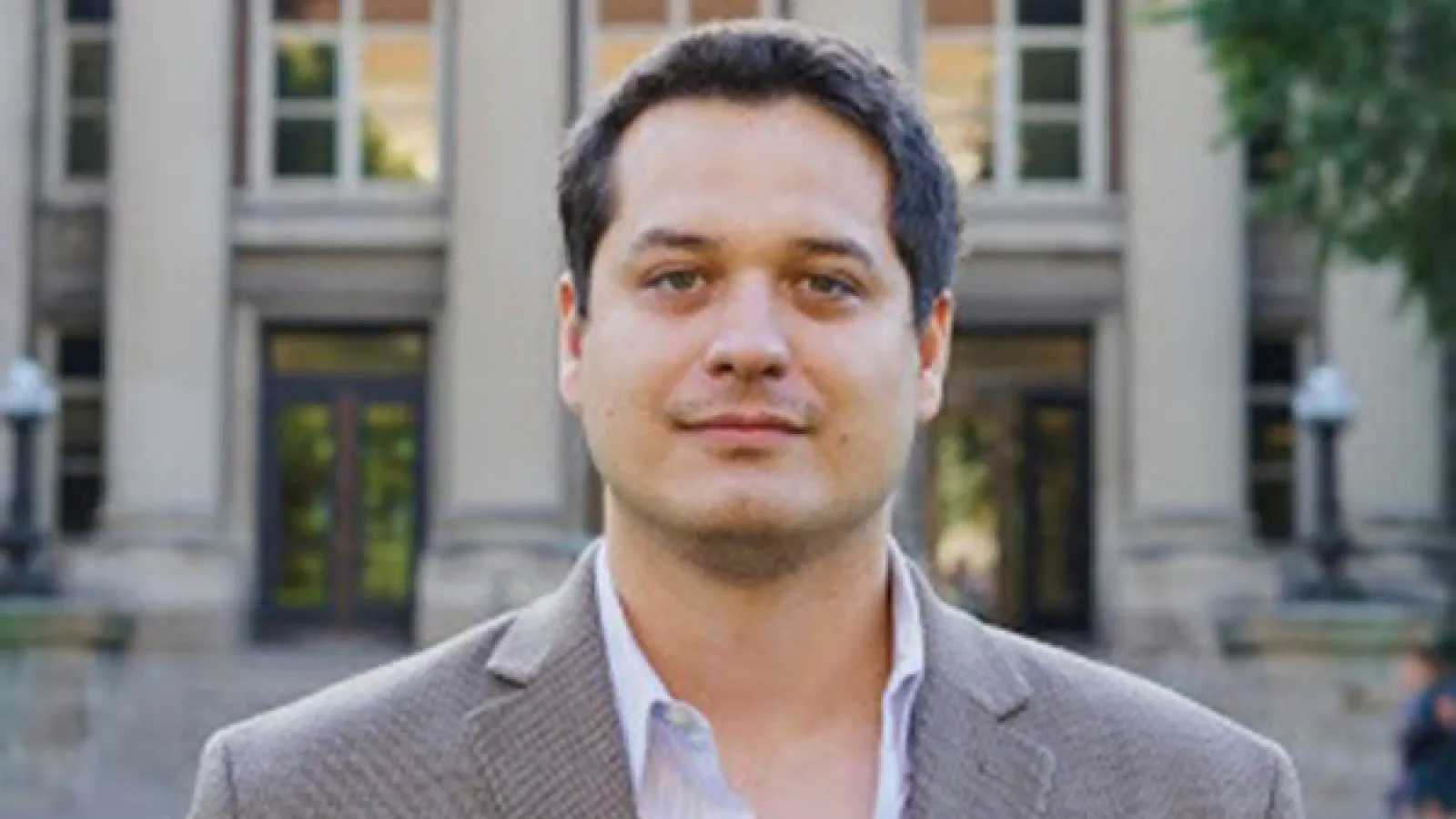
Dr. David Punihaole, University of Vermont
Seminar Title: "Towards developing spectroscopic tools to investigate amyloid fibril structures related to Alzheimer’s Disease and Cerebral Amyloid Angiopathy"
ABSTRACT: Amyloid fibrils are insoluble, non-crystalline protein aggregates that are commonly associated with many diseases, such as Alzheimer's Disease (AD), Cerebral Amyloid Angiopathy (CAA), and Type II Diabetes. Amyloid fibrils exhibit structural polymorphism, which can influence their toxicity, how they grow, and propagate. Investigating how different fibril polymorphs aberrantly interact with their local biological environment is critical to understanding the clinical variations of diseases observed in patients. Unfortunately, investigating this is challenging, as there is a lack of biophysical methods to monitor the structure and dynamics of fibrils in their native biological environments. Here, we discuss our group’s work in addressing this problem. We are developing characterization methods using Raman microscopy to quantitatively assess the molecular-level structure of fibrils. For example, we recently developed methods to measure important dihedral and bond orientation angles in fibrils. To determine the molecular-level structure of different polymorphs, we use these angular measurements as experimental constraints in molecular dynamics simulations. The resulting simulations from the production runs yield an ensemble of structures that are consistent with the experimental Raman data. We are working towards translating some of our methodologies towards Raman imaging applications to quantitively assess amyloid fibril structures found in plaques from brain tissue of AD and CAA patients.
BIO: David Punihaole received both his B.S. in Molecular Biology and Ph.D. in Molecular Biophysics and Structural Biology from the University of Pittsburgh. He performed his graduate studies under Sanford Asher developing UV Resonance Raman spectroscopy techniques to characterize protein aggregates associated with Huntington’s Disease. He then performed his postdoctoral studies under Renee Frontiera at the University of Minnesota, where he pioneered Raman chemical imaging and super-resolution techniques. In 2018, he was the only postdoctoral researcher in chemistry or physics selected by the National Academy of Sciences to be awarded a Ford Foundation Postdoctoral Fellowship. He is currently an Assistant Professor of Chemistry at the University of Vermont. In 2023, he became a Research Project Leader at the Vermont Center for Cardiovascular and Brain Health (VCCBH), an NIH-funded Center of Biomedical Research Excellence (COBRE). His research lies at the intersection of analytical and physical chemistry, as well as biophysics, materials science, and neuroscience. His research group is focused on developing chemical imaging tools that utilize Raman spectroscopy to directly visualize the molecular-level structural dynamics and non-covalent interactions of molecules in living cells. His group is interested in using this novel imaging technology to investigate protein folding regulatory mechanisms, understand the structural basis of amyloid fibril toxicity in neurodegenerative disorders such as Alzheimer’s Disease, and to establish structure-activity relationships of polymer- and lipid-based nanoparticle delivery vehicles used to transport drugs and therapeutic nucleic acids in gene/cancer therapies.