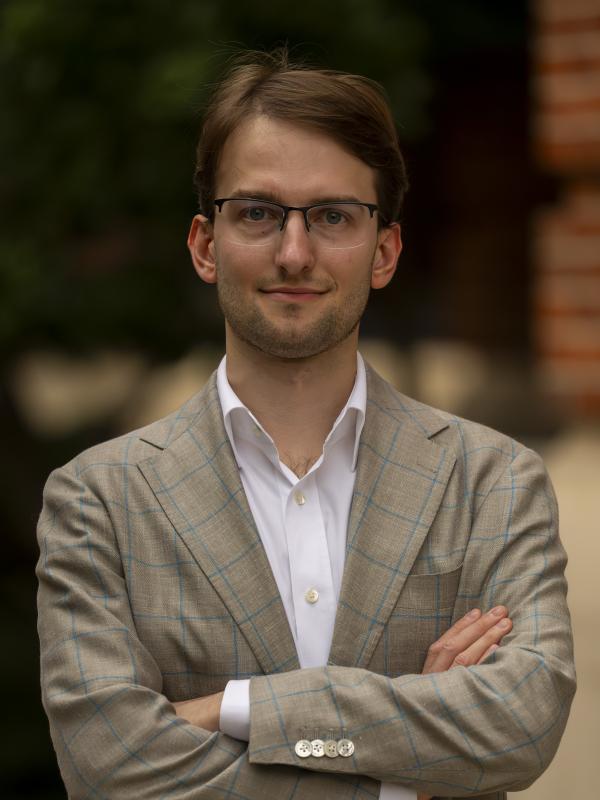
Grigorii Skorupskii
Contact Information
- Skorupskii.1@osu.edu
- Office
- NW 3111
Bio
Grigorii Skorupskii received his Ph.D. in Chemistry from the Massachusetts Institute of Technology in 2021, studying electrically conductive metal-organic frameworks under the supervision of Professor Mircea Dincă. Grigorii continued his academic training as an Arnold O. Beckman Postdoctoral Fellow in the group of Professor Leslie Schoop at Princeton University, investigating magnetism of rare-earth intermetallics. Grigorii joined Ohio State’s Department of Chemistry and Biochemistry in 2026 as an Assistant Professor. In his research, Grigorii combines chemical intuition, big-data-driven machine learning, and experimental synthetic work to design and produce new solid-state materials with applications in electronics, catalysis, and more.
Research Overview
Critical technologies of tomorrow depend on materials chemists to translate complex physics into real systems, and applications ranging from nuclear fusion to artificial intelligence require us to make quantum effects like superconductivity or complex magnetism accessible and controllable. The Skorupskii laboratory uses synthetic solid-state chemistry, spectroscopy, and physical-property and structural analysis to understand how structure and bonding underlie these quantum effects and can allow us to control them.
- Controlling electronic and magnetic orders with post-synthetic chemistry
Materials with complex magnetic and electronic orders can be used in faster, denser, and more efficient data storage, helping meet the demands of the rapidly scaling data center and AI industries. Some examples of such materials include noncollinear magnets where magnetic moments are ordered but point in different directions, and charge density wave solids which host periodic lattice distortions linked to their electronic structures. Proof-of-concept application studies confirm the promise of these materials, but many performance hurdles remain. The Skorupskii laboratory uses post-synthetic chemical transformations, including electrochemical redox and molecular intercalation, to reveal how these orders form and respond, and to optimize their properties for practical use in spintronics.
- Shaping electronic dimensionality of materials
Macroscopic quantum phenomena often become pronounced in materials with low dimensionality. This drove intense research on structurally low-dimensional materials such as graphene. But electrons can display the same low-dimensional behavior in materials that are structurally three-dimensional. This distinction between structural and electronic dimensionality is central to the research in the Skorupskii laboratory, which seeks to understand what makes materials electronically low-dimensional, what drives their formation, and how they can be controlled. Among electronically low-dimensional solids, the laboratory’s current priority is the discovery of new superconductors. The conventional low-temperature superconductors used industrially for half a century require extremely low temperatures and have strict limits on the magnetic fields superconducting coils can sustain. Intermetallics with low-dimensional electronic structures may offer a route to replacing them. The Skorupskii laboratory combines large-scale database analysis with materials synthesis and experimental property study to shape the electronic structures of intermetallic superconductors and to raise the temperatures and fields at which they operate.
- Chemistry of liquid metals
Molten metals are critical across many industries, both as intermediates in the production of solid-state metallic materials, and as effective thermal conductors or even catalysts. In their molten form, metals and alloys are often thought to have homogeneous, randomly distributed atoms. There is, however, growing evidence that molten metals have similarities to traditional low-temperature solutions, possessing short-range order shaped by the constituent elements’ bonding preferences. The Skorupskii laboratory combines synthesis, spectroscopy, and physical property analysis to better understand this short-range order, and how to optimize to achieve specific goals in crystal growth and catalysis.
Publications
Publications (if applicable):
Skorupskii, G., Orlandi, F., Robredo, I., Jovanovic, M., Yamada, R., Katmer, F., Vergniory, M. G., Manuel, P., Hirschberger, M. & Schoop, L. M. “Designing giant Hall response in layered topological semimetals”
Nat. Commun. 15, 10112 (2024)
Skorupskii, G., Le, K. N., Cordova, D. L. M., Yang, L., Chen, T., Hendon, C. H., Arguilla, M. Q. & Dincă, M. “Porous lanthanide metal–organic frameworks with metallic conductivity”
Proc. Natl. Acad. Sci. U. S. A. 119, e2205127119 (2022)
Skorupskii, G., Trump, B. A., Kasel, T. W., Brown, C. M., Hendon, C. H. & Dincă, M. “Efficient and tunable one-dimensional charge transport in layered lanthanide metal–organic frameworks”
Nat. Chem. 12, 131–136 (2020)